
Muse Wearables
At Muse Wearables, I design end-to-end connected experiences that bridge physical hardware, mobile interfaces, AI-driven intelligence, and secure payment ecosystems within everyday wearable technology.
MY ROLE
Interaction Designer
Leading product design across health tech, fintech, and AI-driven wearable experiences
FOCUS AREA
Product Strategy, UX Research, Mobile App Design, Payment Flows, AI Interaction Design, Design Systems
TIMELINE
November 2025 – Present
Bangalore, India
A) Menstrual Health Tracking
Turning a fragmented product idea into a launch-ready health feature
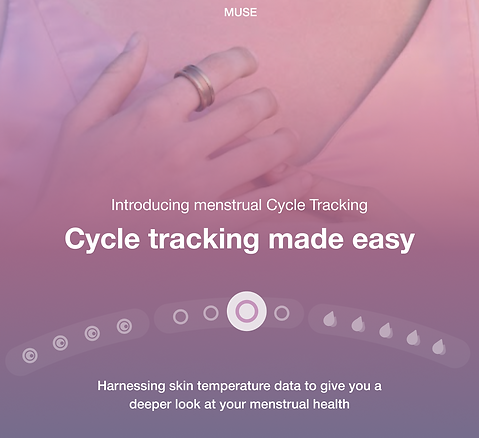
The menstrual health tracking feature had been explored internally for several months before I joined, with early concepts, unfinished screens, and scattered product thinking distributed across multiple documents and design files. My role began with consolidating this fragmented groundwork and transforming it into a cohesive, launch-ready product experience that could be executed within startup timelines.

The Challenge
The primary challenge was not creating a feature from scratch, but navigating ambiguity. The project existed in fragments, incomplete design explorations, loosely defined requirements, and evolving product expectations. At the same time, leadership wanted the feature released quickly, which meant identifying the smallest possible version that still delivered meaningful user value while remaining technically feasible for development.
My Role
• Worked alongside product leadership during early-stage product discovery
• Contributed to PRD definition and feature prioritization
• Developed user personas and mapped behavioral patterns to identify intervention opportunities
• Explored multiple AI interaction models for contextual assistance and personalization
• Participated in iterative concept development to define the product direction before interface design
B) Muse Wallet (in production)
Reimagining NFC payments for wearable-first interactions
Muse Wallet is an NFC-enabled payment ecosystem designed to extend secure digital payments to a smart ring interface, enabling users to make seamless tap-to-pay transactions without relying directly on their phone during payment interactions.


*Not showcasing detailed UI screens as project is in production
The Challenge
Designing for wearable payments introduced constraints far beyond traditional mobile app design.
Unlike conventional payment experiences, this ecosystem required balancing extremely limited interface real estate, high security expectations, hardware dependencies, and real-world transaction uncertainty while ensuring the experience remained trustworthy and intuitive for everyday users.
User → Smart Ring → Authentication → Wallet → Bank/Card → Payment Terminal → Transaction Confirmation
My Role
• Led end-to-end UX/UI design for Muse Wallet
• Designed onboarding and payment setup experiences for first-time users
• Architected authentication flows balancing security with frictionless interactions
• Designed transaction handling and wallet management workflows
• Collaborated closely with backend engineers and product managers to align technical payment infrastructure with user experience requirements
Complex Design Problems Solved
A major part of this project involved translating highly complex backend payment infrastructure into user flows that felt invisible, frictionless, and trustworthy.
The challenge was designing confidence around a system users cannot fully see — ensuring secure authentication, minimizing transaction friction, and handling edge cases where physical hardware, digital systems, and payment infrastructure all interact simultaneously.
Learnings
This project strengthened my ability to think beyond interface design and approach product experiences as interconnected systems.
It deepened my understanding of designing around technical constraints, security-sensitive workflows, and interactions where physical and digital touchpoints must operate seamlessly together.
C) Rio AI (In production)
Designing intelligent product experiences through AI-assisted personalization


Core Product Question
The central challenge was understanding when intelligent assistance genuinely improves user experience rather than becoming unnecessary automation.This required thinking beyond interface design and carefully identifying moments where contextual AI could provide meaningful value based on user behavior, habits, and long-term engagement patterns.
Discovery & Opportunity Identification
Worked closely with product leadership to define Rio AI's role within the Muse ecosystem. Conducted exploratory research around user behaviours, health habits, and long-term engagement patterns to identify moments where intelligent assistance could create value.
Exploration & Iteration
The team explored multiple directions, beginning with a journaling experience focused on self-reflection and emotional tracking. This evolved into investigating the relationship between:
-
Ring data (sleep, vitals, activity)
-
User-provided inputs (mood, cycles, habits)
-
Contextual AI prompts and insights
Several concepts, including habit-tracking interventions, were prototyped and evaluated before being discarded due to limited alignment with core user needs and AI potential.
Product Strategy & Definition
Contributed to product discovery and PRD definition by:
-
Identifying target personas and use cases
-
Mapping user behaviours and engagement patterns
-
Defining feature opportunities and AI intervention points
-
Collaborating on feature prioritization and product direction
My Contribution
-
Product discovery and concept development
-
Persona identification and user behaviour mapping
-
AI opportunity identification and feature strategy
-
PRD definition and iterative concept exploration
-
Cross-functional collaboration with product leadership on Rio AI's vision and direction
Scripted and executed a product storytelling video to introduce Rio AI 'Applets', visualizing its features, interactions, and real-world use cases through motion graphics and contextual UI scenarios. The aim was to keep it simple and in context
RIO 'Applets' product storytelling video creation